

Table of Contents
- Why Touchscreen Compatible Heated Gloves for Winter Matter
- Quick Comparison: What to Look for in Winter Heated Gloves
- How We Tested Touchscreen Compatible Heated Gloves
- Material, Warmth and Touchscreen Sensitivity
- Heated Gloves for Raynaud's Disease: Pain Relief and Dexterity
- Battery Life of Heated Gloves: What to Expect
- How to Clean Heated Gloves Without Damaging Them
- Conclusion
- Frequently Asked Questions
Last Updated: September 21, 2026
Why Touchscreen Compatible Heated Gloves for Winter Matter
Touchscreen compatible heated gloves for winter solve a problem that ordinary gloves cannot: staying warm while keeping full use of your phone. At Mind Smart, we build thermotherapy gloves for people who cannot afford to choose between warmth and function, from Raynaud's sufferers to cold storage crews.

That combination matters more than most buyers realise. Cold hands lose fine motor control quickly, and fumbling a glove off to answer a call defeats the purpose of wearing it. The NHS guidance on Raynaud's notes that keeping hands warm is one of the most effective ways to reduce attacks, which makes a glove you actually keep on a medical decision as much as a comfort one.
Below, we break down what separates a glove that works from one that sits in a drawer, including how we test, what materials matter, and what to expect from battery life.
Quick Comparison: What to Look for in Winter Heated Gloves
The most important features in winter heated gloves are touchscreen sensitivity, heat coverage across the fingers, waterproofing, battery life and fit. Get any one of these wrong and the glove underperforms, no matter how good the rest of the specification looks.
Use this checklist before buying:
| Feature | What Good Looks Like | Why It Matters |
|---|---|---|
| Touchscreen compatibility | Works across thumb and index finger | You keep gloves on to use a phone |
| Heat coverage | Full hand and fingertips | Finger warmth drives dexterity |
| Waterproofing | Sealed, watertight elements | Wet gloves lose heat fast |
| Battery life | Several hours at mid setting | Covers a commute or shift |
| Fit | Snug, measured by palm width | Traps heat, allows movement |
| Grip | Silicone palm grip | Safe handling of tools and rails |
A glove that scores well on all six is worth the money. One that only ticks the warmth box will let you down the first time you need to send a message in the cold.
How We Tested Touchscreen Compatible Heated Gloves
We tested touchscreen compatible heated gloves for winter by using them in real cold, not a laboratory. Our team wore them outdoors in damp, sub-zero conditions, checking touchscreen response, heat distribution, battery drain and grip while carrying out everyday tasks.
Testing focused on four things:
- Touch sensitivity: typing, scrolling and answering calls without removing the glove
- Heat retention: how quickly warmth reached the fingertips and how long it lasted
- Dexterity: handling keys, zips, tools and phone screens
- Weatherproofing: performance in rain, sleet and wet snow
The gloves that scored best shared one trait: conductive thread woven into the fingertips rather than a coating sprayed on top. Coatings wear through in weeks. Woven conductive thread keeps working.
Material, Warmth and Touchscreen Sensitivity
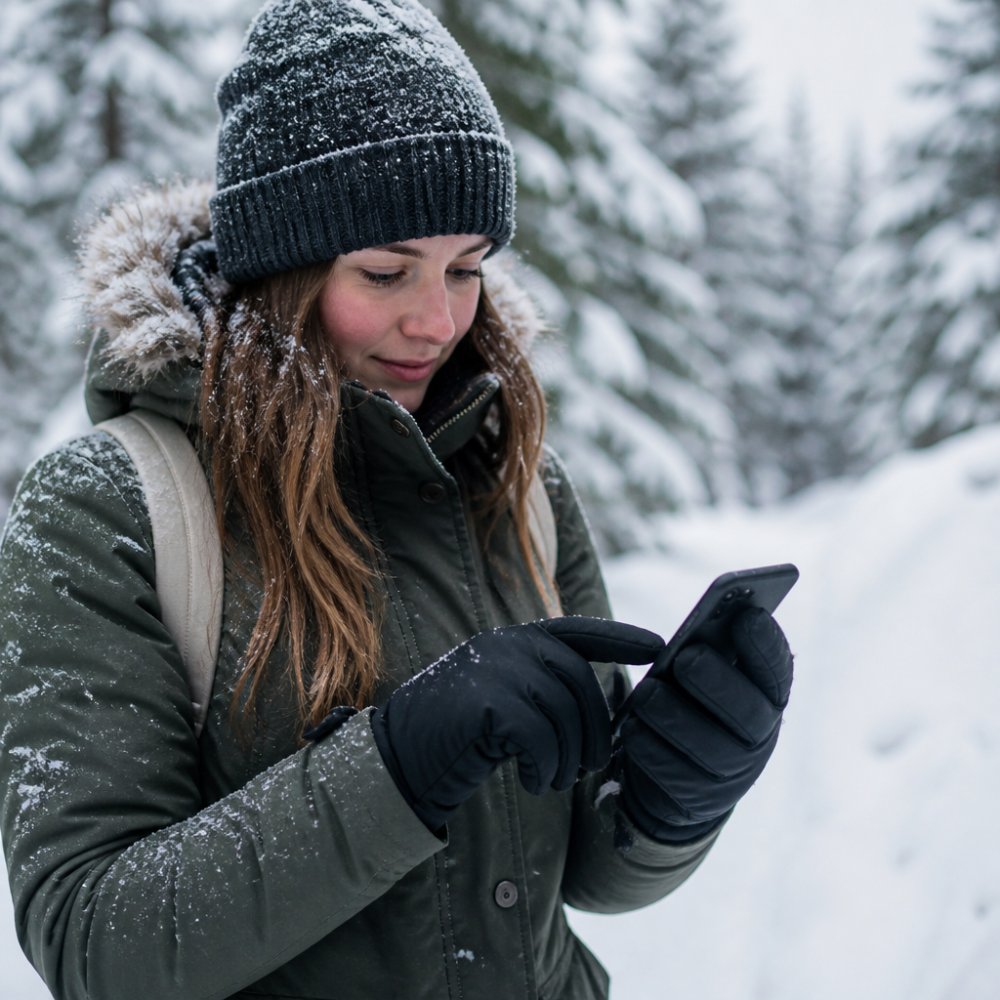
Material choice decides how warm a glove feels and how well it works with a screen. Insulation traps heat, while conductive thread in the fingertips carries the touch signal your phone needs.
Look for these material features:
- Thermal insulation and synthetic lining, often fleece-lined, for heat retention
- Conductive thread at thumb and index fingertips for touch sensitivity
- Waterproof membrane plus windproof outer fabric for weatherproofing
- Moisture-wicking lining to manage sweat during high-exertion activities
- Silicone grip on the palm for control
Breathability matters as much as warmth.
Heated Gloves for Raynaud's Disease: Pain Relief and Dexterity
Heated gloves for Raynaud's disease work by keeping the hands warm enough to reduce the blood vessel narrowing that triggers attacks. To understand why some gloves help more than others, it helps to know what is actually happening in the fingers.
Why fingers go cold first
In cold conditions the body protects its core by narrowing the blood vessels near the skin, a response called vasoconstriction. The fingers and toes are at the end of the circulation line, so they lose warmth first and regain it last. In Raynaud's, that normal response is exaggerated: the vessels constrict sharply and stay constricted, which is why fingers turn white, then blue, then red as flow returns, often with numbness and pain.
Mind Smart l Rechargeable Waterproof →
Dexterity is the part most buyers underestimate
Bulky gloves can warm your hands but leave you unable to grip a cup, a key or a tool. For anyone with Raynaud's, dexterity is not a comfort issue, it is a safety one. Numb fingers drop things, miss zips and fumble keys, and the Health and Safety Executive guidance on hand-arm vibration notes that cold, numb hands reduce grip and control. A slim, ergonomic fit keeps tactile feedback intact.
Living with Raynaud's day to day
A few practical habits make heated gloves work harder:
- Warm the hands before you go out, not after they go numb. Prevention is easier than recovery.
- Keep the wrists covered. Blood reaches the fingers through the wrist, so a gap at the cuff undoes much of the benefit.
- Avoid tight cuffs and watch straps. Pressure on the wrist can itself provoke an attack.
- Carry a spare battery on long days out. A glove that runs out mid-afternoon leaves you worse off than no glove at all.
For anyone managing arthritis alongside Raynaud's, the same logic applies: warmth eases stiffness, and a close fit keeps joints mobile. If attacks are frequent, severe or affect your daily life, speak to a pharmacist or GP, heated gloves manage symptoms, they do not treat the underlying condition.
Battery Life of Heated Gloves: What to Expect
Battery life of heated gloves depends on the heat setting, the ambient temperature, the cell capacity and the age of the battery. Most gloves run longest on their lowest setting and drain fastest on maximum heat, but the gap between settings is larger than most buyers expect: a glove rated at several hours on low may deliver well under two hours on high in sub-zero conditions.
What affects runtime:
- Heat setting: lower settings extend runtime significantly, often two to three times the high-setting figure
- Cell capacity: measured in milliamp-hours (mAh); a larger cell adds weight but buys runtime
- Battery chemistry: lithium-ion cells hold charge well but lose capacity over hundreds of charge cycles
- Charging: USB-C charging is faster and more convenient than older micro-USB
- Conditions: extreme cold reduces usable capacity, so a battery stored in a cold car or rucksack starts the day already down
Lithium-ion battery safety: a checklist most guides skip
- Charge with the supplied charger or a reputable USB-C source. Cheap unbranded chargers without overcharge protection are a common cause of cell damage.
- Do not charge a cold battery straight from the outdoors. Let it return to room temperature first; charging a sub-zero cell stresses it.
- Do not leave a fully charged battery on permanent charge. Unplug once the indicator shows full.
- Store at around half charge if the gloves will sit unused for months. Full or empty storage accelerates capacity loss.
- Stop using a battery that swells, gets hot for no reason, or smells unusual. Dispose of it at a household waste recycling centre that accepts batteries, never in general waste.
- Keep spare batteries in an inner pocket, not an outer one. Body heat keeps them closer to their operating range.
Mind Smart gloves are proven effective down to -38°C, tested in extreme cold and wet conditions.
How to Clean Heated Gloves Without Damaging Them
How to clean heated gloves comes down to one rule: protect the electronics. Remove the batteries first, then hand wash in cool water with a mild detergent. Never wring, tumble dry or dry clean heated gloves.
A safe routine:
- Remove batteries and any detachable liners
- Hand wash in cool water with mild soap
- Rinse gently, without twisting
- Press water out with a towel
- Air dry flat, away from radiators and direct heat
- Reinsert batteries only once fully dry
Conclusion
Cold hands should not cost you your grip, your phone or your comfort. The right pair of touchscreen compatible heated gloves for winter keeps you warm, functional and connected, whether you are commuting, working outdoors or managing Raynaud's.
Frequently Asked Questions
Do heated gloves work with smartphone touchscreens?
Yes, touchscreen compatible heated gloves use conductive thread woven into the fingertips. This allows the electrical signal from your finger to pass through the fabric to the screen. Look for gloves specifically labelled touchscreen compatible. Mind Smart's heated gloves work with all capacitive touchscreens, so you can answer calls, use maps or send messages without removing them in the cold.
Are heated gloves safe for people with Raynaud's disease?
Heated gloves are generally safe for Raynaud's sufferers and many find them helpful for managing symptoms. The gentle, consistent warmth promotes circulation and reduces the frequency of attacks. Choose gloves with adjustable heat settings so you can avoid overheating. Mind Smart's thermotherapy gloves are designed for Raynaud's and arthritis relief, with three thermostat-controlled settings and watertight heating elements for safe, even warmth.
How long do the batteries in heated gloves typically last?
Battery life varies by heat setting and glove model. Most heated gloves run between 2 and 8 hours on a single charge. Mind Smart's rechargeable heated gloves deliver up to 12 hours of battery life, depending on conditions. Cold temperatures can reduce lithium-ion performance, so keep spare batteries warm if you plan extended outdoor sessions.
Can you wash touchscreen compatible heated gloves?
Most heated gloves are hand-wash only. Remove the batteries first, then gently hand wash in cool water with mild detergent. Never machine wash or tumble dry, as this damages the heating elements and conductive thread. Rinse thoroughly, squeeze out excess water without wringing, and air dry flat away from direct heat. Always check the manufacturer's care label before cleaning.


Leave a comment
This site is protected by hCaptcha and the hCaptcha Privacy Policy and Terms of Service apply.