
Last Updated: November 7, 2026
Quick Summary
You need a portable power bank for outdoor gear because cold temperatures, long days and constant use drain batteries far faster than at home. A power bank stores energy from mains power and releases it when you have no access to an outlet, keeping phones, headlamps and heated gloves running.
- Cold weather can drain batteries far faster than normal use in a warm room.
- Calculate needed capacity by listing devices, their mAh and charges per day, plus a 20 to 30 percent buffer.
- Cold weather can add a further 20 to 30 percent capacity buffer on winter trips.
- Carry the power bank in an inside pocket against your body to keep it warm.
- Keep a charged power bank as an emergency backup for calls, navigation and weather updates.
Table of Contents
- Why Outdoor Gear Runs Out of Power Faster Than You Expect
- How to Work Out Your Power Bank Capacity for Camping
- Choosing the Best Power Bank for Hiking
- Why Cold Weather Drains Batteries and How to Plan For It
- Charging Heated Gloves With a Power Bank
- Emergency Use, Battery Safety and Solar Limitations
- Packing Your Power Bank for Your Next Trip
- Frequently Asked Questions
Why Outdoor Gear Runs Out of Power Faster Than You Expect
Your phone dies at the worst moment. Your heated gloves go cold halfway up the trail.
A full charge can feel like it lasts forever in a warm kitchen. Put the same gear on a frozen ridge and the story changes quickly.
So what does a power bank actually do? It stores energy when you have access to mains power, then releases it when you don't.
- Phones lose charge faster when it's cold and when GPS and screens run constantly.
- Heated gloves need steady power to keep the heating elements running.
- Headlamps and watches add up across a multi-day trip.
How to Work Out Your Power Bank Capacity for Camping
The right power bank depends on how long you're out and what you need to charge. Start with your devices. Note how many charges each one needs per day, then multiply that across your trip length.
A simple method works well for most people:
- List every device that needs charging, such as phone, headlamp and heated gloves.
- Check each device's battery capacity in mAh.
- Estimate how many full charges you'll need per day.
- Add a spare buffer of around 20 to 30 percent for cold weather losses.
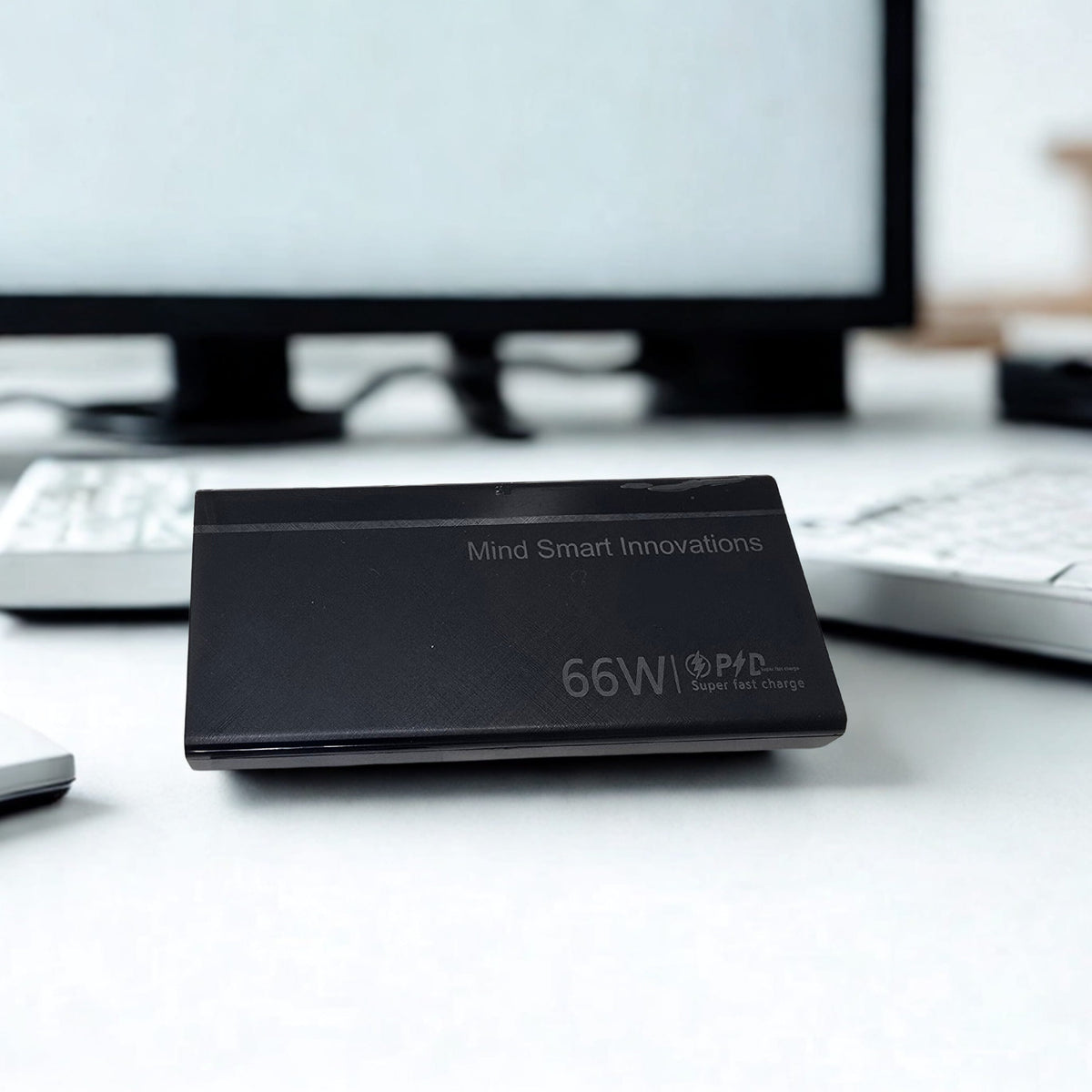
For a weekend camping trip, a higher-capacity bank usually works best. The Mind Smart Portable Power Bank 66W has a 10,000mAh capacity and 66W output, which suits charging several devices across a short trip.
Choosing the Best Power Bank for Hiking
On a hike, weight matters as much as capacity. Every extra gram adds up over miles of uphill walking. Pick a power bank that fits easily into a pocket or the side of your pack.
Look for these points when comparing options:
- Capacity: Enough to top up your phone and gloves for the full day.
- Output: Higher wattage charges devices faster, so you spend less time waiting at camp.
- Size and weight: Compact models stay out of the way on steep sections.
- Build quality: A tough casing handles knocks and wet conditions.
The Mind Smart Portable Power Bank 66W is a good example of a hiking-friendly option. It packs a lot of output into a compact body, so it's easy to carry without adding bulk.
Why Cold Weather Drains Batteries and How to Plan For It
Cold weather is the single biggest reason outdoor gear runs out of power when you need it most. Lithium-ion cells, the chemistry inside almost every phone, headlamp, heated glove and portable power bank, rely on chemical reactions that slow down as temperature falls.
The effect is not linear. Battery capacity generally holds up reasonably well down to around freezing, then falls away more sharply as temperatures drop further.
A practical cold-weather planning method
- Estimate your warm-weather capacity need first. Add up the mAh of every device you will charge and multiply by the number of full charges you expect per day, then by trip days. Add 20-30 percent for charging losses (no power bank delivers 100 percent of its rated capacity to a device).
- Apply a cold derating. For trips where temperatures will sit near or below freezing for long periods, add a further 20-30 percent capacity. For deep winter conditions, assume you may get noticeably less than the rated capacity in usable output.
- Plan around warming, not just capacity. A power bank kept warm delivers closer to its rating, so warming is often more effective than simply carrying a bigger bank.
Warming and storage practices that actually work
- Carry the power bank against your body. An inside jacket pocket or a chest pocket keeps it near 30°C or so, which is close to ideal. An outer pack pocket or trouser pocket exposed to wind will not.
- Charge devices while both are warm. Charging a cold phone from a cold power bank is the worst combination: the phone may refuse to accept charge or charge very slowly, and the bank loses more energy to resistance. Warm both in a pocket for ten minutes before connecting.
- Do not charge inside a sleeping bag. It is tempting on a winter trip, but heat builds up with no airflow. Charge in a cool, ventilated part of the tent instead, and keep the bank in your sleeping bag only when it is not charging.
- Expect the phone to be the weak link. Many phones protect themselves in the cold by shutting down or throttling. A phone that switches off at 30 percent in the cold is not necessarily broken; warming it may recover the indicated charge.
Bringing a cold power bank straight into a warm tent can cause condensation. Let it warm gradually in a pocket or dry bag rather than placing it near a stove or heater.
What this means for trip planning
For a winter day trip, a 10,000mAh bank with 66W output is a sensible baseline for a phone, a headlamp and a pair of heated gloves, provided you keep it warm. If you are heading out in serious cold, our guide on choosing a portable power pack for winter gear goes further into capacity and cold-weather performance.
The article's cold-weather planning steps can be summarised as a quick reference, so you can check each stage before you set off.
| Step | What to do | Time or frequency |
|---|---|---|
| Estimate warm-weather need | Add up device mAh and multiply by charges per day | Per trip day |
| Add charging losses | Add 20-30 percent buffer | Every trip |
| Apply cold derating | Add a further 20-30 percent for near or below freezing | Cold trips |
| Warm the bank | Carry it against your body in an inside pocket | Before use |
| Warm both before charging | Warm bank and device in a pocket for ten minutes | Before connecting |
| Avoid charging in a sleeping bag | Charge in a cool, ventilated tent area | Every charge |
Charging Heated Gloves With a Power Bank
Heated gloves are one of the most useful things to charge on a cold-weather trip.
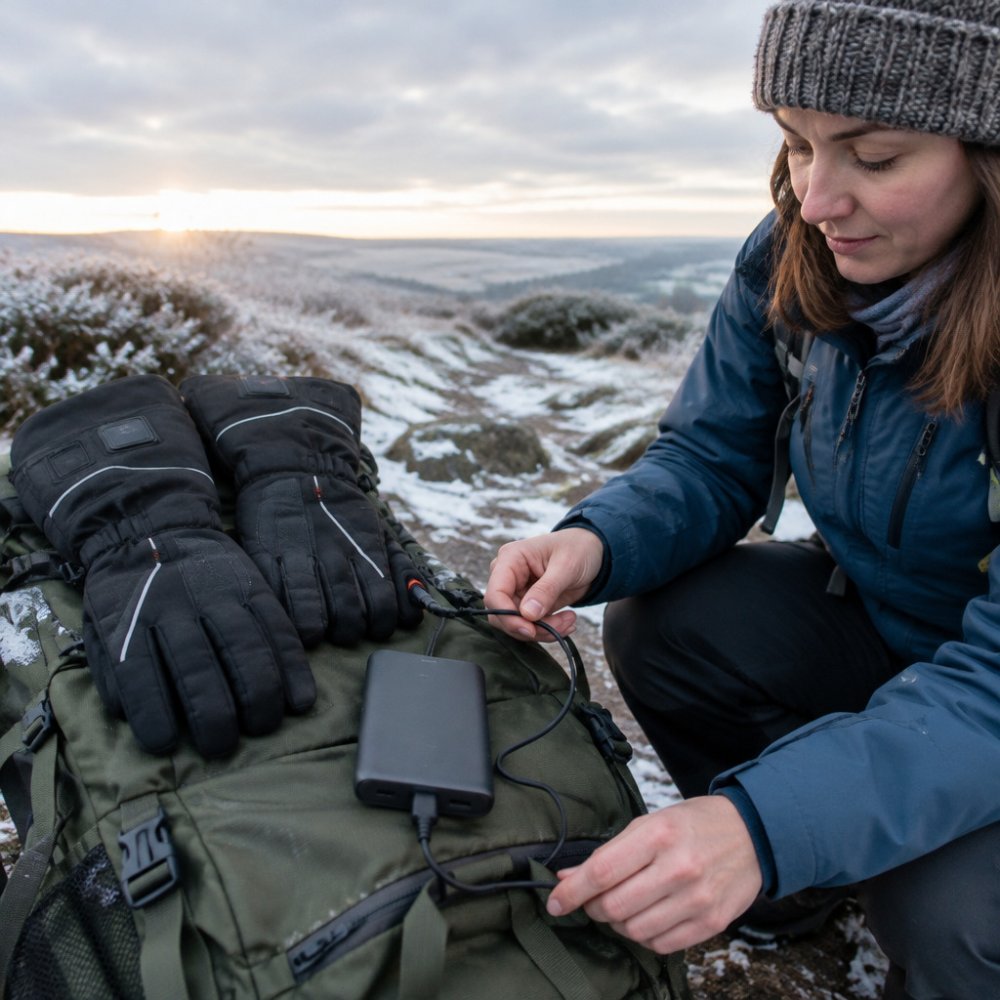
Before you rely on this setup, check the glove's battery capacity and how long a full charge lasts. Then match that against your power bank.
Keep the heating settings low when you can. Higher heat settings use more power and drain both the gloves and the bank faster.
Emergency Use, Battery Safety and Solar Limitations
A power bank is not just a convenience outdoors, it is a safety item. A charged phone is your route to emergency services, your navigation backup, your weather forecast and your way of letting someone know you are safe. A dead phone is none of those things. That is the strongest argument for carrying backup power on any trip where you will be out of signal or away from mains power for more than a day.
Emergency and safety use cases
- Calling for help. In the UK, 999 and 112 are the emergency numbers, and a phone with even a weak signal can often connect. A power bank that revives a flat phone at dusk can be the difference between a call and a cold night out.
- Navigation backup. Map apps and GPS tracking drain a phone quickly. Keeping the phone topped up means you retain a backup to a paper map and compass rather than replacing them.
- Emergency communication. Satellite messengers and personal locator beacons have their own batteries, but many pair with a phone for messaging. A charged phone keeps that pairing available.
- Weather updates. Mountain weather can change fast. A phone that still has charge lets you check forecasts at the last point of signal before committing to a route.
A simple emergency routine: keep the power bank charged to at least 50 percent before every trip, charge the phone in priority order (navigation and communication first), and never let the phone drop below around 20 percent without topping it up. Carry the charging cable you actually need, a bank with no cable is dead weight.
Battery safety and lifespan
Lithium-ion power banks are safe when treated properly, but they degrade and can fail if abused.
- Store out of direct sun and away from heat. Never leave a power bank in a hot car, on a radiator or next to a stove. Heat is the main cause of accelerated degradation and, in rare cases, swelling.
- Check before every trip. Look for swelling, cracks, a distorted casing or a bank that gets unusually hot during charging. If you see any of these, stop using it.
- Do not charge under a pillow or inside a sleeping bag. Heat builds up with no airflow. Charge in a ventilated spot.
- Respect airline rules. Spare lithium batteries must travel in cabin baggage, not checked luggage, and most airlines apply capacity limits, commonly 100Wh, with higher-capacity banks needing approval. Check your airline's rules before flying.
Watch out: a swollen power bank should not be charged or used, even if it still works. Isolate it, keep it away from flammable materials and take it to a recycling centre as soon as you can.
Solar charging: realistic expectations
Solar panels are often marketed as a way to keep a power bank topped up outdoors. In practice, they are best treated as a supplement rather than a main source, since cloud, low sun and terrain shade can reduce output considerably.
Use solar to slow the drain on a sunny lunch stop or a long camp day, not as your plan for keeping devices charged.
Packing Your Power Bank for Your Next Trip
Packing well means your power bank is charged, protected and easy to reach. Keep it in an inside pocket or a small dry bag, with the cable clipped nearby.
Before you leave, run through this checklist:
- Power bank fully charged
- Cables for phone, gloves and headlamp packed
- Power bank stored close to your body for warmth
- Heated gloves fully charged
- Spare capacity for the full trip length
If you're weighing up winter options, our guide on choosing a portable power pack for winter gear covers capacity and cold-weather performance in more depth. Readers deciding how to power their gloves may also find our comparison of heated gloves versus portable power banks useful, along with a look at whether rechargeable heated gloves are worth it.
For a closer look at the Mind Smart option mentioned above, you can see the Mind Smart 66W power bank and check its specifications for your own trip planning.
Frequently Asked Questions
Why should you carry a power bank outdoors?
Phones, headlamps, GPS devices and heated gloves all rely on batteries that drain faster in cold air, and there is often no mains socket on a hillside or campsite. A power bank gives you a dependable reserve for navigation, emergency calls and warmth. Carrying one means a flat phone on a long walk becomes an inconvenience rather than a serious problem. Choose a model with enough capacity for your longest day and keep it in an inside pocket so the battery stays warm.
How do you choose a power bank for hiking or camping?
Start with capacity, then check output and weight. Multiply the number of devices you need to charge by how many times each will need topping up, and add a margin for cold weather losses. Look for USB-C output that matches your devices and a body you can carry comfortably. Mind Smart's Portable Power Bank 66W, priced at £32.99, combines 10,000mAh with 66W output and a compact, rugged body, which suits day hikes and weekend trips well.
Can you charge heated gloves with a power bank?
Yes, provided the power bank's output and the glove's charging connection are compatible. Heated gloves are rechargeable USB devices, so a power bank with a suitable USB port can top them up in the field. Charge the gloves before setting out, check the connection before you leave home, and keep the power bank warm so it delivers its rated output. Mind Smart's heated gloves are advertised with up to 8 hours of continual warmth on a full charge.



Leave a comment
This site is protected by hCaptcha and the hCaptcha Privacy Policy and Terms of Service apply.