
Last Updated: November 1, 2026
Quick Summary
Heated gloves deliver warmth while portable power banks extend it, so most winter setups need both. A power bank only runs heated clothing safely when output voltage, current draw, connector type and cable rating all line up, so check the glove's manual before pairing.
- Heated gloves are garments with heating elements woven into the fabric; power banks are batteries that store energy for charging devices.
- Heating elements typically pull between 0.5A and 2A per glove depending on the heat setting.
- A 10,000mAh bank holds roughly 37Wh, about ten times a 1,000mAh glove battery's 3.7Wh.
- Allow 15-20% for conversion losses, treating 37Wh as roughly 30Wh of usable energy.
- A 10,000mAh bank on medium heat gives roughly 3-4 hours per glove pair in mild cold.
Table of Contents
- Heated Gloves vs Portable Power Banks: What Each One Does
- Heated Gloves Battery Comparison: Built-In Packs vs External Power Banks
- Power Bank Compatibility with Heated Clothing
- Heated Gloves Battery Life: What Runtime Really Looks Like
- Calculating Runtime from Power Bank Capacity
- Heated Gloves Charging and Care: Protecting Your Batteries
- Build Your Winter Setup with Mind Smart
- Frequently Asked Questions
Heated Gloves vs Portable Power Banks: What Each One Does
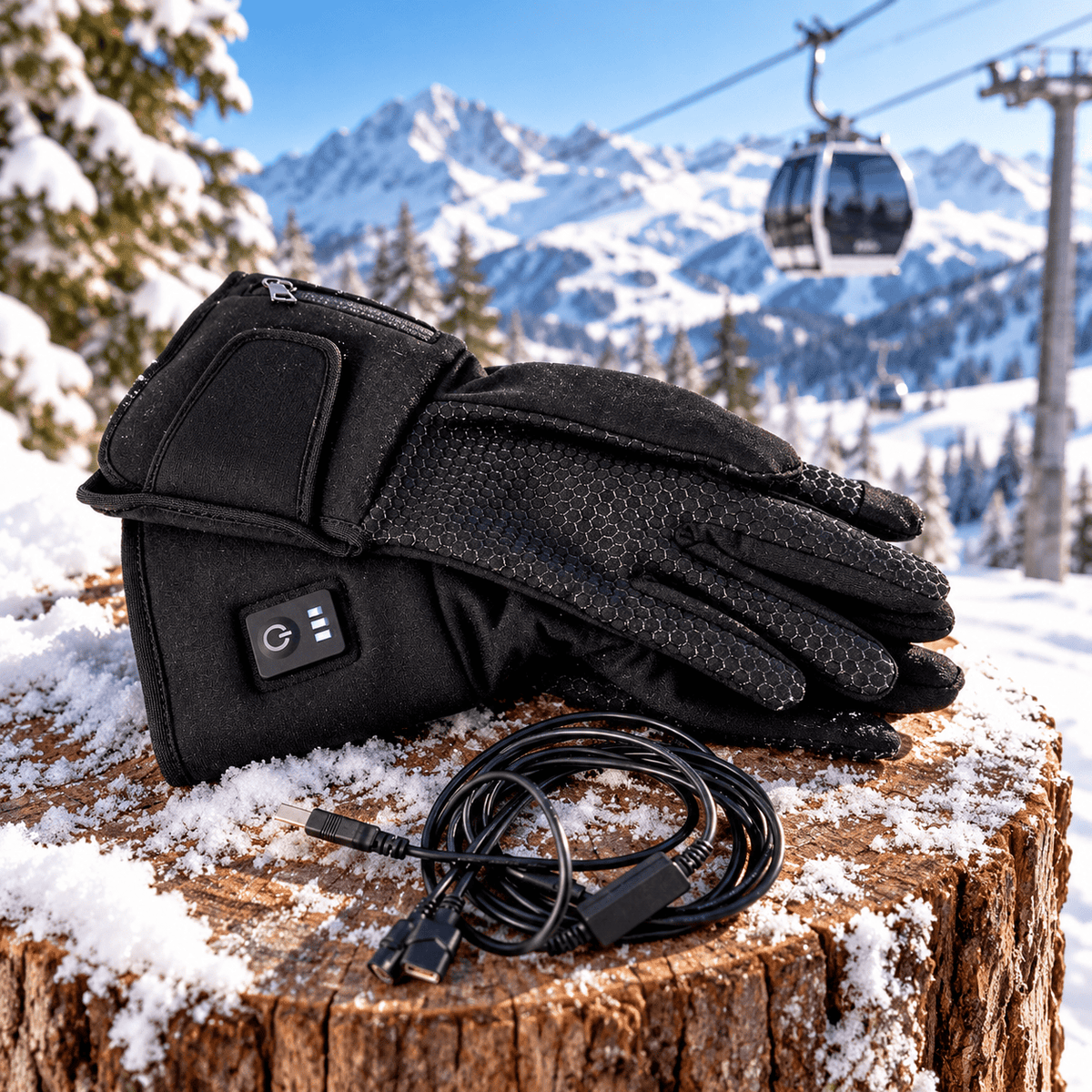
Heated gloves and portable power banks solve two different halves of the same winter problem, and confusing them is why so many people end up cold. To see the actual Mind Smart Rechargeable Heated Gloves being compared, the product page lays out their features and specifications. At Mind Smart, we build both, so we see the misunderstanding constantly: a heated glove is a garment with heating elements woven into the fabric, while a power bank is a battery that stores energy for charging devices. One keeps your fingers warm. The other keeps your gloves running.
The distinction matters more than it sounds. A pair of battery-powered gloves without a charged battery is just an expensive pair of gloves. A power bank without a compatible glove or cable does nothing for your hands at all. The real question is how the two work together, and that's what this comparison covers.
Here's the short version: heated gloves deliver warmth, power banks extend it. Most winter setups need both.
The two products do different jobs, and most winter setups need both.
| Item | What it is | What it does |
|---|---|---|
| Heated glove | Garment with heating elements woven into fabric | Keeps your fingers warm |
| Power bank | Battery that stores energy for charging devices | Keeps your gloves running |
Heated Gloves Battery Comparison: Built-In Packs vs External Power Banks
Rechargeable heated gloves can be powered by a built-in battery pack or an external power bank, and each option has trade-offs in runtime and convenience.
An external power bank can extend runtime, but it needs a cable and somewhere to sit. The Mind Smart Direct USB Power Extension Cable connects gloves straight to a power bank, so the gloves keep heating even when their own batteries are flat.
Neither option is universally better. Each suits different situations, depending on how long you need to stay warm.
Power Bank Compatibility with Heated Clothing
Compatibility is where most people get caught out, and it is the part the keyword is really asking about. A power bank only runs heated clothing safely when four things line up: the output voltage, the current the heating elements draw, the connector type, and the cable's current rating. Get any one wrong and you either get no heat or a cable that warms up faster than your gloves.
Voltage and current. USB rechargeable gloves draw power through a standard USB connection, so check the input specification in the glove's manual before pairing it with a bank. The figure that matters is current, measured in amps. Heating elements typically pull somewhere between 0.5A and 2A per glove depending on the heat setting, and a power bank must be able to supply that continuously on the port you use. A 10,000mAh pack rated at 66W total output has ample headroom; a tiny 2,500mAh promotional bank often cannot sustain 2A on a single port without throttling or shutting down.
Connectors. Check which connector your glove uses before buying a power bank, so the two are compatible. The Mind Smart Direct USB Power Extension Cable connects gloves directly to a power bank.
Pass-through and overcurrent protection. Pass-through charging, using the power bank while it is itself on charge, is convenient but not all banks support it, and some that do reduce output while charging. Look for a bank with built-in overcurrent, overvoltage and short-circuit protection; these are standard on reputable units and are your safeguard if a cable is damaged or a connector gets wet. Avoid unbranded banks with no protection circuitry, especially in cold, damp conditions where condensation is common.
Manufacturer guidance. Always follow the glove maker's stated input specification in the product manual.

If you want to see the exact power bank we pair with our gloves, the Mind Smart 66W power bank page lists the full specifications, including per-port current limits.

Heated Gloves Battery Life: What Runtime Really Looks Like
Battery life claims deserve scepticism, and we would rather show you the variables than a single headline number. Runtime depends on three things: the heat setting, the outdoor temperature, and the age of the battery. Cold weather slows the chemical reaction inside any lithium-ion battery, so the same pack that runs for hours indoors will fall short on a freezing moor.
Our heated gloves offer three heat settings through a push-button thermostat. Higher settings drain the battery faster, so choose the setting that suits your needs.
The honest answer: treat manufacturer runtime figures as a best case, then plan a backup.
Calculating Runtime from Power Bank Capacity
You can estimate runtime yourself, but the honest version uses watt-hours rather than milliamp-hours, because mAh alone hides the voltage. The sum is: watt-hours of the bank, multiplied by conversion efficiency, divided by the glove's power draw in watts. That gives runtime in hours.
Mind Smart Rechargeable Heated Gloves →
Step 1, convert capacity to watt-hours. A power bank's mAh figure is quoted at the internal cell voltage, usually 3.7V. So a 10,000mAh bank holds roughly 10Ah × 3.7V = 37Wh. A small 1,000mAh glove battery holds about 3.7Wh. That ten-to-one ratio is the real story behind 'a bigger bank lasts longer'.
Step 2, allow for conversion losses. The bank boosts 3.7V to 5V USB output, and the glove's electronics may regulate again. A common pattern is 80-85% end-to-end efficiency, so knock 15-20% off the watt-hours before dividing. Treat 37Wh as roughly 30Wh of usable energy.
Step 3, divide by glove draw. Heating elements on low might draw around 2W per glove (4W for the pair); on medium around 4W per glove (8W); on high around 6-7W per glove (12-14W). These are illustrative figures, check your glove's stated wattage. Using 30Wh usable:
- Low (4W pair): about 7.5 hours
- Medium (8W pair): about 3.75 hours
- High (13W pair): about 2.3 hours
Step 4, correct for cold. Lithium-ion cells lose usable capacity as they chill. A bank carried in an outside pocket at around freezing may deliver noticeably less than one kept in an inside pocket near body heat. A common pattern is a 10-20% shortfall in near-freezing conditions, worsening in severe cold. Warm the bank before use and carry it close to the body.
Step 5, compare with measured results. Estimates are a planning tool, not a guarantee. Our 8-hour heated gloves battery test records actual runtime by heat setting, and the measured figures sit within the range the calculation predicts once cold and conversion losses are applied. If your own setup falls well short of the estimate, suspect a thin cable, a tired battery or a connector fault before blaming the glove.
The Mind Smart Battery Charging Extension Cable lets you charge from a power bank or car USB port while you are on the move.
Heated Gloves Charging and Care: Protecting Your Batteries
Good charging habits help preserve battery life. Recharge before the pack drops to empty, and store gloves somewhere dry and cool. When washing, secure the USB caps and use a wash bag on a gentle 30°C cycle.
If something does go wrong, check the connector and battery before assuming a fault with the glove.
Best for: daily commuters and skiers who want a self-contained pair. Skip if: you work long outdoor shifts and need continuous heat all day, in which case an external power bank setup suits you better.
Build Your Winter Setup with Mind Smart
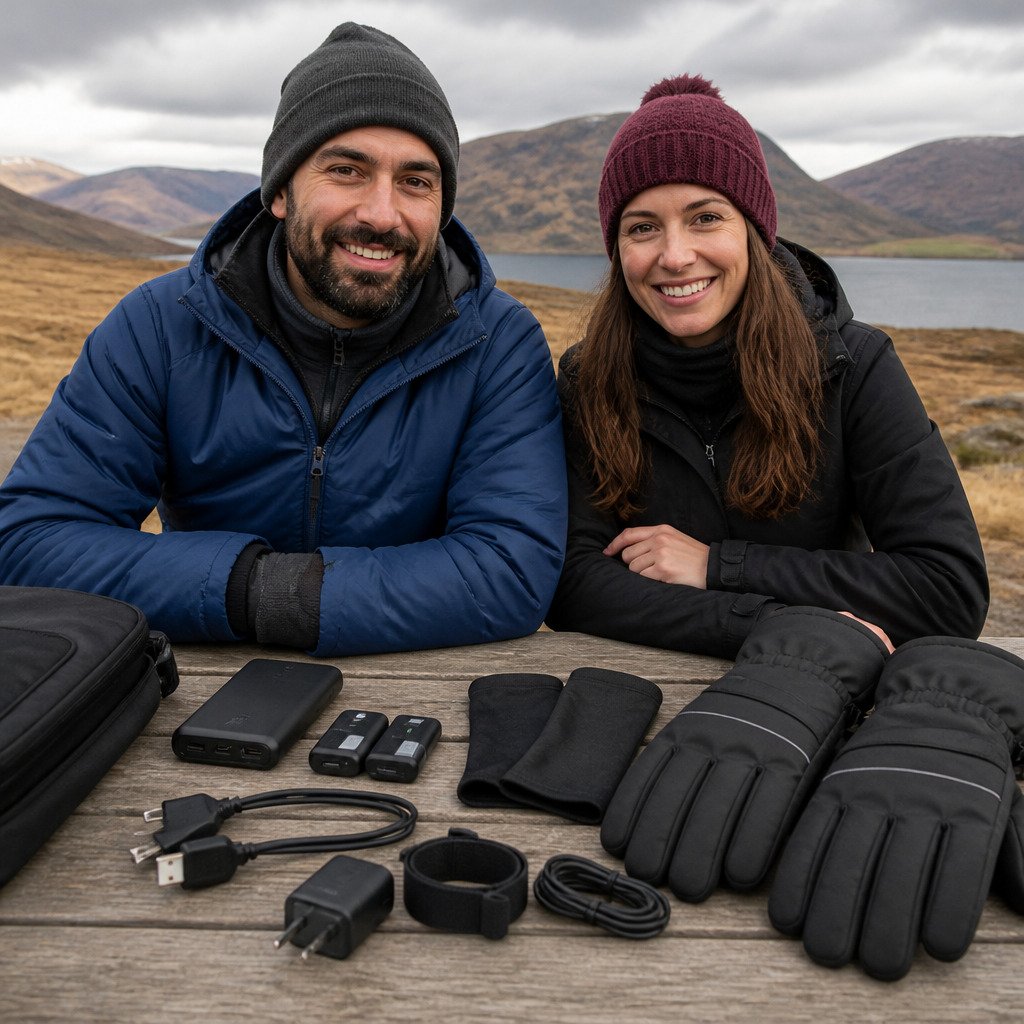
The right setup depends on how long you are outside and how cold it gets. For most people, a pair of heated gloves covers the daily commute and weekend walks. For anyone working outdoors through a full shift, adding a power bank and a direct USB cable turns a few hours of warmth into all-day heat.
Our gloves feature waterproof and breathable fabric, heating that covers the full hand and fingertips, touchscreen compatibility, and a low-profile design. They have been trialled by trawlermen working in extreme cold and wet conditions in the North Sea.
Get started with Mind Smart and keep your hands warm from the first cold morning to the last.
Frequently Asked Questions
Can you use a portable power bank with heated gloves?
Yes, but only with the right cable and a compatible glove design. Mind Smart sells a Direct USB Power Extension Cable (£24.99) that connects gloves straight to a power bank, so you get continuous heat even when the glove batteries are flat. Check that your power bank has a USB output that matches your glove's input specification.
What battery capacity is best for heated gloves?
It depends on how long you need heat. The Mind Smart Portable Power Bank 66W (£32.99) has a 10,000mAh capacity for extended power. For all-day work in extreme cold, carry a spare or use the direct cable to run from the bank while the glove batteries recharge. Match capacity to your longest session rather than buying the biggest bank you can find.
How long do heated gloves last on a full charge?
Runtime varies with heat setting, outside temperature and battery age. Mind Smart Rechargeable Heated Gloves (£89.99) are rated for up to 12 hours of heating, with three thermostat-controlled settings so you can trade warmth for duration. Higher heat settings will generally run for less time than lower ones.
Can cold weather affect a power bank's performance?
Yes. Lithium-ion cells deliver less capacity in freezing conditions, so a power bank kept in an outside pocket may underperform. Keep the bank in an inside pocket close to your body and connect it with a cable long enough to reach your gloves. The Mind Smart Battery Charging Extension Cable (£20.99) lets you charge from a power bank or car USB port.
How do you maintain heated gloves and their batteries?
Wash gloves gently at 30°C with the USB caps secured and use a wash bag to protect the heating elements. Store batteries partly charged rather than fully drained, and recharge them before each season. Avoid sharp bends in cables and keep connectors dry.
Winter does not negotiate, and neither should your gear. If you are tired of cold fingers halfway through a shift, Mind Smart has you covered with rechargeable heated gloves, a 66W portable power bank, and the cables that link them into one reliable system. Get started with Mind Smart and build a winter setup that lasts the whole season.



Leave a comment
This site is protected by hCaptcha and the hCaptcha Privacy Policy and Terms of Service apply.